The analogue signal isolator — also called a safety isolation barrier or signal transmitter — belongs to signal conditioning and chiefly fights interference. Its exceptional interference immunity makes it very widely used in automation systems. As industrial automation deepens, more primary sensors are deployed with ever higher accuracy and sensitivity demands, and control programs grow more complex. In complex industrial sites, interference sources — motor starting/stopping, large-contactor switching, thyristor phase control, arcing, pulses, electromagnetic waves — must be fully considered at design stage: isolation measures cut every possible interference path and secure system reliability, a decisive factor of success. Passing the industry-standard 4–20 mA DC signal through an isolator to give complete galvanic isolation is indeed one of the effective anti-interference measures in today's automation systems.
Signal isolators work mainly with DCS/PLC systems, completing and supplementing the analogue I/O cards and enhancing the reliability of field and remote signals. The MHM-05A needs no auxiliary supply: two input terminals, two output terminals, in a slim module that clips onto standard DIN rail — installation, removal and maintenance are very convenient, and multiple units stack compactly on the rail, saving or replacing I/O terminal blocks in the cabinet.
The MHM-05A is passive and isolated: single input, single isolated output, 4–20 mA in, 4–20 mA out.
| Specifications | |
|---|---|
| Specification | Value |
| Typical input signal | 4-20 mA |
| Typical output signal | 4-20 mA |
| Output load resistance (current output) | ≤ 250 Ω |
| Frequency response | ≤ 1000 Hz |
| Accuracy | 0.5% |
| Linearity | 0.5% |
| I/O isolation voltage | DC 1500 V (1 minute) |
| Operating temperature range | -10~+70℃ |
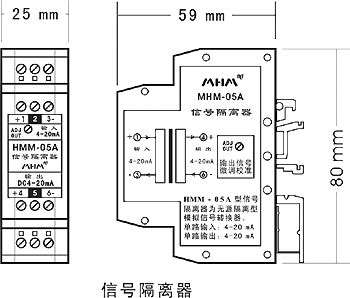
| Dimensions | 80mm(H) × 25mm(W) × 70mm(D) DIN |
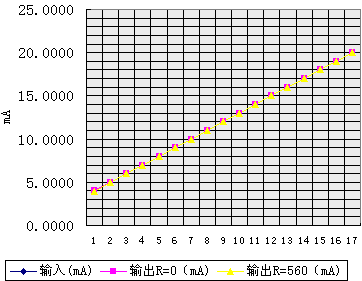
2. Curve graph
3. Outside dimensions
4. Type table
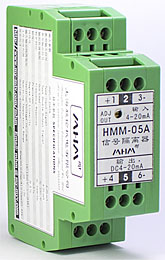
Example: input 4–20 mA, output 4–20 mA.
5. Cautions Input on terminals 1/3, output on terminals 4/6. The output can be calibrated on site via the A adj trimmer on the panel. The product is calibrated before dispatch — adjustment by unauthorised personnel is not advised.