The rotary discharge valve — also called a star valve, rotary airlock, rotary feeder or blow-through valve — usually consists of a vaned rotor, housing, seals, gearbox and motor. Material from the hopper above falls by gravity into the pockets between the vanes and is discharged at the bottom as the rotor turns, so the star valve feeds material quantitatively and continuously.
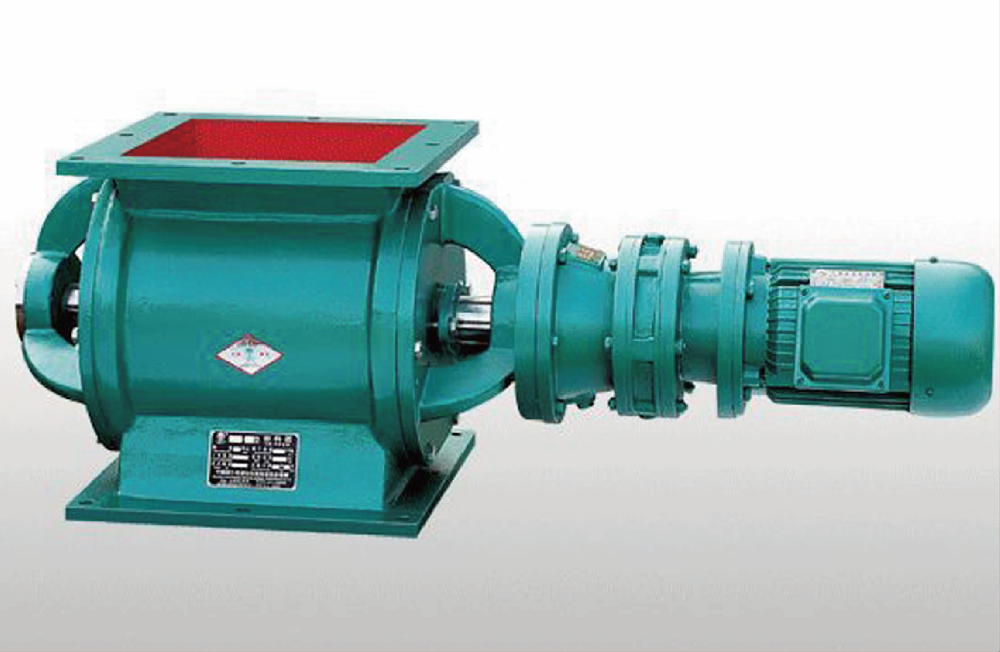
Star valves are commonly used in pneumatic conveying systems. For both pressure and negative-pressure systems, the valve feeds material into the conveying line evenly and continuously, keeping the gas-to-solids ratio stable so that pneumatic conveying works properly; at the same time it separates the pressures above and below, acting as an airlock. The star valve is therefore a key component of pneumatic conveying systems.
It is particularly suitable for dusts and small granular materials, widely used in environmental protection, metallurgy, chemical, grain, cement, road construction and drying-plant projects. In power plant ash handling, star valves work alongside isolation dampers and disc valves for quantitative ash discharge and air locking between the ash hopper and the conveying line.
W = V × N × P × 60 ÷ 1000
| Symbol | Meaning |
|---|---|
| W | Discharge rate (m³/h) |
| V | Geometric volume per rotor revolution (L/r) |
| N | Rotor speed (r/min) |
| P | Filling factor of the material (≤100%) |
Filling factors: granular materials P≈0.6–0.9; powders P≈0.5–0.8. These factors are indicative only — for special materials, measure in actual operation.
Our damper column also offers damper classification and structure and why damper seal-air systems are necessary; for valve selection and supply, feel free to contact us.